Baby Hat Size Chart by Age (Preemie to 3 Years)
A newborn hat is about 13–14 inches around and 5½ inches tall. Make the hat 1–2 inches smaller than the head. That last part is the bit the charts leave out, and it is the difference between a hat that stays on and a hat that ends up on the floor of a supermarket.
The size chart
Head circumference is the measurement that matters. Hat height is measured from the brim edge to the crown.
| Age | Head circumference | Hat circumference (finished) | Hat height |
|---|---|---|---|
| Preemie | 10–12 in / 25–30 cm | 9–11 in | 4–5 in |
| Newborn | 13–14 in / 33–36 cm | 12–13 in | 5½ in |
| 0–3 months | 14–15 in / 36–38 cm | 13–14 in | 6 in |
| 3–6 months | 15–17 in / 38–43 cm | 14–15½ in | 6½ in |
| 6–12 months | 17–18 in / 43–46 cm | 16–17 in | 7 in |
| 12–24 months | 18–19 in / 46–48 cm | 17–18 in | 7½ in |
| 2–3 years | 19–20 in / 48–51 cm | 18–19 in | 8 in |
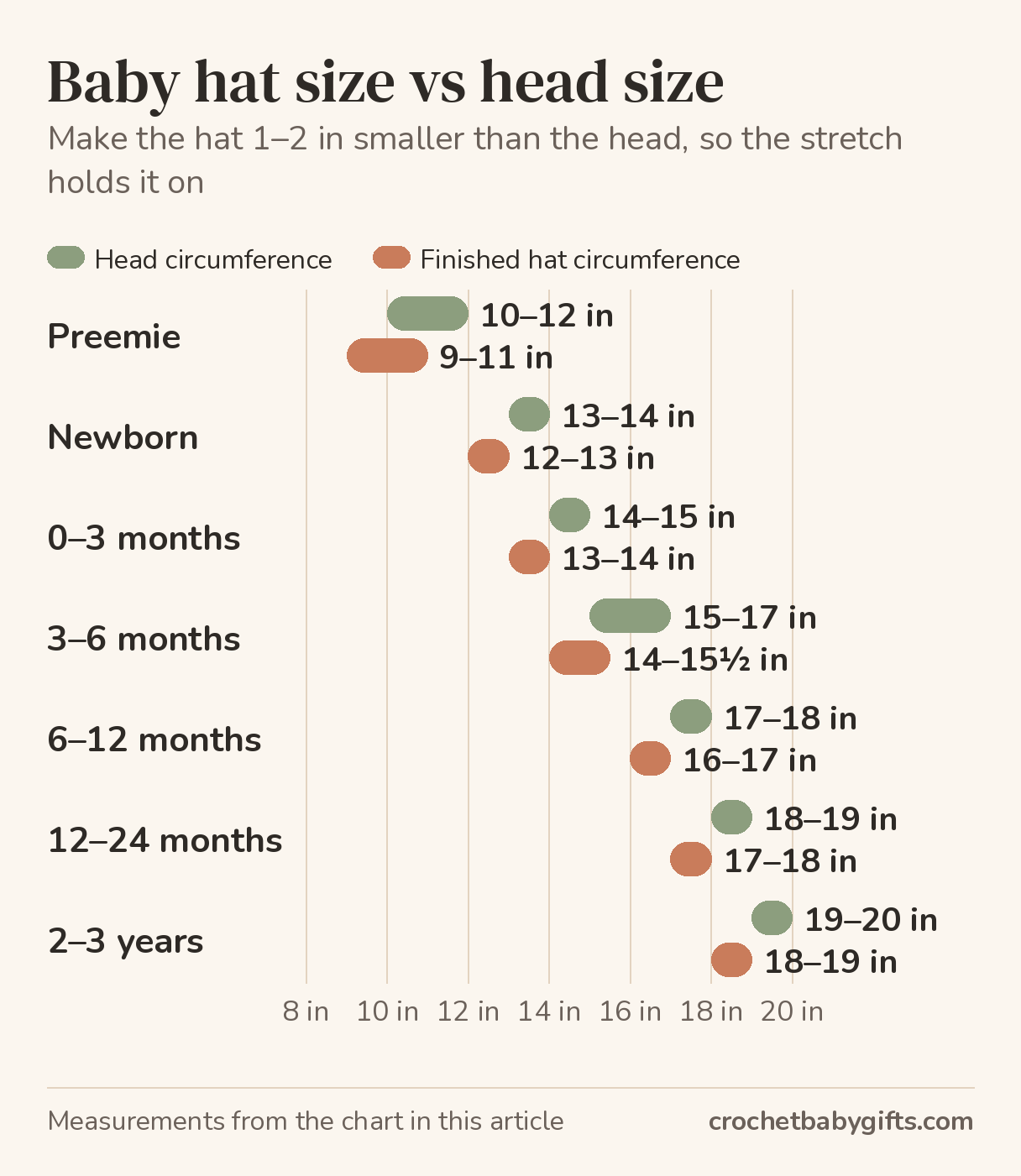
If you are making a gift and do not know the baby’s head: make the 3–6 month size. Newborn hats fit for about three weeks. The 3–6 month size will fit at some point with near-certainty, and a slightly big hat is a usable hat where a small one is not.
Negative ease — the rule that makes it stay on
A hat has to stretch slightly to grip. If you crochet a hat to the exact head circumference, it sits loose and rides up.
Make the finished hat 1–2 inches smaller than the head measurement. That is negative ease. The fabric stretches to fit and stays put.
How much to use:
- 1 inch for a firm, dense stitch with little give — single crochet, or anything in cotton.
- 2 inches for a stretchy fabric — ribbing, a stretchy yarn, a looser gauge.
Get this wrong in the generous direction and the hat comes off. Get it wrong in the tight direction and it leaves a mark, so 1–2 inches is the whole usable range.
Why the age column is the least reliable number here
Head circumference at a given age varies more between healthy babies than almost any other measurement people crochet to. Two perfectly normal six-month-olds can be an inch and a half apart, which is a whole size step on the chart above.
Age is a proxy. The head is the measurement. If you can get it — a tape measure around the widest part, just above the ears and eyebrows — use it and ignore the age column entirely.
If you cannot, two things help:
- Ask for the birth weight. It correlates better with head size at newborn stage than the due date does.
- Add a ribbed brim. A ribbed band stretches over a range of about 1½ inches, which absorbs most of the uncertainty. It is the single most forgiving design choice in a baby hat.
Preemie hats have their own rules
Many hospital NICU programmes accept handmade hats and most publish their own requirements, which override everything on this page. Common ones:
- Exact dimensions, often smaller than the preemie row above.
- Machine-washable, tumble-dryable yarn only — hospital laundry is hot.
- No pompoms, buttons, ribbons, ties or open lacework.
- Sometimes a specific fibre, because of skin sensitivity and infection control.
Ask before you start, not after. A batch of hats made to the wrong spec cannot be donated.
Measuring a hat you have already made
Lay it flat, measure the width across the brim, and double it. That is the circumference. Do not stretch it while measuring — you want the relaxed measurement, because that is the number the negative-ease rule applies to.
For height, measure from the brim edge to the centre of the crown, flat.
What most hat charts get wrong
They give head circumference and stop. Head circumference is not hat circumference. Without the negative-ease step the chart produces hats that do not stay on, which is the only failure mode that matters.
They present the age brackets as if they were tight. They are wide, overlapping ranges. A chart that says “6 months = 17 inches” is stating the middle of a range as though it were a fact.
They rarely mention the ribbed brim, which solves more sizing problems than any amount of chart precision.
Frequently asked questions
What size hat for a newborn? 13–14 inch head, so make the hat 12–13 inches around and about 5½ inches tall.
How do I measure a baby’s head for a hat? Tape measure around the widest part — just above the eyebrows and ears, around the back of the skull. Snug, not tight.
Should a baby hat be tight? Slightly snug, not tight. It should stay on without leaving a mark. That is what the 1–2 inch negative ease produces.
What size should I make if it is a gift? 3–6 months. Newborn size is outgrown in weeks and everyone else gives newborn.
Do preemie hats need special yarn? Usually yes — check with the specific hospital. Machine-washable and tumble-dryable is the common requirement, with no attachments of any kind.
How tall should a baby hat be? Roughly 5½ inches for a newborn, rising to about 8 inches at age three. See the chart.