Crochet Pencil Case Pattern: A Free Single-Crochet Zipper Case in Three Sizes
Crochet one rectangle in single crochet, sew a zipper to two of its edges, fold it in half and seam the sides. For a case that holds standard 7½-inch pencils, make the rectangle 10 × 10 inches and use a 9-inch zipper. That takes about 160 yards of worsted-weight cotton and a 4.5 mm hook, and it is one stitch from start to finish.
Download the free printable PDF: the whole pattern, the size table and the step diagram, ready to print. No sign-up.
Pick your size
| Size | Rectangle to crochet | Zipper | Finished, flat | Finished, boxed corners | Holds | Yarn (estimate) |
|---|---|---|---|---|---|---|
| Mini | 8 × 8 in | 7 in | 8 × 4 in | 7 × 3½ in, 1 in deep | Crochet hooks, erasers, a sharpener | about 100 yd |
| Standard | 10 × 10 in | 9 in | 10 × 5 in | 8½ × 4¼ in, 1½ in deep | Standard 7½-inch pencils | about 160 yd |
| Large | 13 × 12 in | 12 in | 13 × 6 in | 11 × 5 in, 2 in deep | Pencils, markers, small scissors | about 245 yd |
The first number of the rectangle is the length of the foundation chain. The second is how tall you work it. The boxed sizes are the base. The zipper edge at the top stays the full width of the rectangle.
The rule behind the zipper column: the zipper is the rectangle’s width minus about an inch, so half an inch of crochet is left free at each end for the side seams. Zippers are sold in a few standard lengths, which is why the rectangles are sized around 7, 9 and 12 inches rather than the other way round.
What you need
The product links in this list are affiliate links. As an Amazon Associate I earn from qualifying purchases, at no extra cost to you.
- Worsted-weight (4) cotton yarn, the amount in the table. Cotton holds a crisp box shape. Acrylic works too, but makes a softer, slouchier case. One option: Lily Sugar’n Cream 100% cotton, worsted.
- A 4.5 mm (US 7) hook. That is deliberately smaller than the 5.5–6.5 mm the yarn weight chart gives for worsted. Tighter fabric means pencil points do not poke through, and the case stands up on its own. One option: Clover Amour 4.5 mm (size 7).
- A zipper in the length from the table. An ordinary nylon dress zipper is fine. For the Standard size: YKK 9-inch #3 nylon zippers.
- A sewing needle, sewing thread to match the yarn, a few pins, a stitch marker (Clover locking markers), a blunt tapestry needle (Clover Chibi bent-tip set) and scissors.
The pattern
The pattern is written to measurements rather than stitch counts, so it works at your gauge. It has not yet been test-made from this page.
Chain 1 at the start of a row does not count as a stitch. Work every stitch through both loops. Measure everything flat and unstretched.
- Foundation. Chain loosely until the chain, laid flat without stretching, measures the rectangle’s first number (10 inches for Standard). Chain 1 more. If your chains tend to be tight, make them with a hook one size larger (5 mm) and switch back to 4.5 mm for Row 1. A tight chain makes the foundation edge shorter than the last-row edge, and the zipper then ripples on one side.
- Row 1. Single crochet in the second chain from the hook and in each chain across. Turn.
- Row 2. Chain 1, single crochet in each stitch across. Turn. Count your stitches against Row 1. If the count changes, the edges will slant.
- Repeat Row 2 until the piece measures the rectangle’s second number from the foundation edge (10 inches for Standard). Fasten off and weave in the ends.
Two-colour version. For a contrast base, work colour A for 3½ inches, colour B for 3 inches, then colour A for the last 3½ inches (Standard size). The B band ends up across the bottom of the case. For Mini use 2½ / 3 / 2½, and for Large 4½ / 3 / 4½. Change colour on the last yarn-over of the last stitch before the new colour starts.
Putting it together
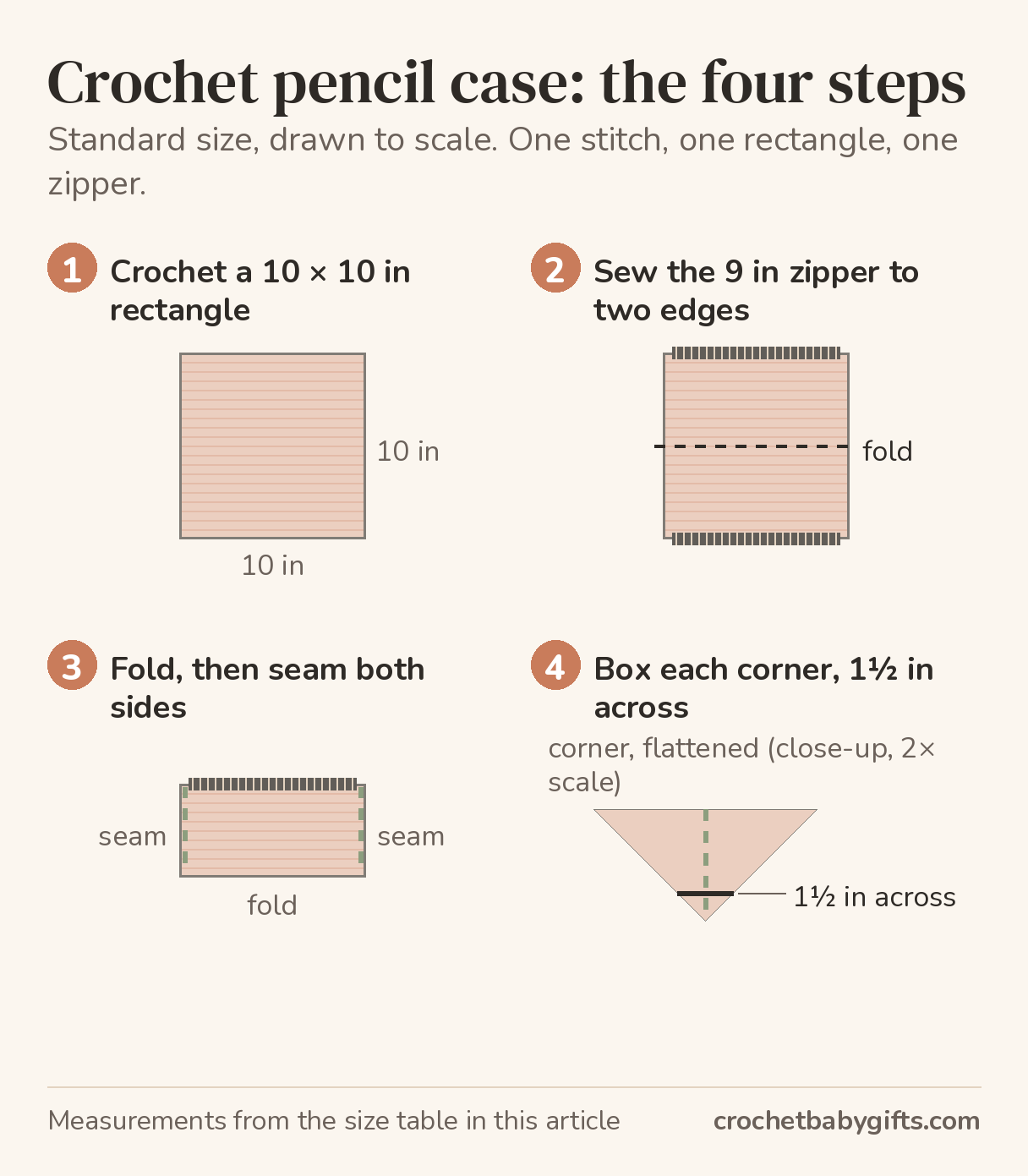
- Sew the first zipper edge. Single crochet looks almost the same on both sides, so pick the neater side as the outside and mark it with a stitch marker. Lay the rectangle outside up with the foundation edge nearest you, and open the zipper fully. Slide one zipper tape, face up, under the foundation edge so the crochet sits 1 to 2 mm from the teeth, with about half an inch of crochet free at each end. Pin from the middle outwards, easing the crochet onto the tape without stretching it. Stretched crochet gives a wavy zipper that will not press flat. Backstitch along the tape.
- Sew the second zipper edge. Fold the rectangle in half, outside out, so the last-row edge meets the free zipper tape and the piece becomes a flat tube. Close the zipper to check that both edges line up end to end. Open it again, then pin and sew the last-row edge to the second tape the same way.
- Open the zipper all the way. The case is turned through this opening at the end, and a half-open zipper leaves too small a gap for stiff cotton.
- Fold and seam. Turn the tube inside out so the zipper runs along the top and the fold is along the bottom. Fold each zipper tape end inwards and tack it down with sewing thread, because a tapestry needle will not pierce zipper tape easily. Seam each side from the fold up to the zipper, through both layers, with yarn and a slip stitch or whip stitch.
- Box the corners (optional). At each bottom corner, flatten the corner into a triangle with the side seam running down its middle and the bottom fold underneath it. Measure across the triangle the “deep” figure from the table (1½ inches for Standard) and sew straight across there with yarn. Do not cut the tip off, because crochet unravels. Fold it flat against the base and tack it down.
- Turn it right side out through the open zipper and push the corners out.
How long it takes
About 3 to 5 hours of crochet for the Standard size, plus about an hour for the zipper and seams. That comes from the time model this site uses for blankets: worsted double crochet at a moderate pace, multiplied by 1.8 for single crochet, applied to a 100-square-inch rectangle. The hour for the zipper is an estimate. Sewing a zipper takes some people far longer the first time.
Where the yarn figures come from
They are worked out, not weighed. How much yarn a baby blanket takes puts worsted double crochet at about 0.95 yards per square inch, and single crochet at about 1.5 times that. Add 10% for seams. The Standard rectangle is 100 square inches, which comes to about 160 yards. Cotton is heavier and less springy than acrylic, so if your total lands close to the end of a ball, buy one more.
The two steps that decide whether it looks neat
The zipper length. A zipper as long as the opening has nowhere for the side seams to go, so the ends bunch up and the seam pulls. The extra inch is what lets the corners sit square.
The hook size. On the hook the ball band suggests, single crochet in worsted can be open enough for a pencil point to push through, and the case is more likely to slump. The smaller hook is not a mistake in the pattern. It is the point of it.
Frequently asked questions
Is this a good first project? It suits a confident beginner. The crochet is one stitch in straight rows. Sewing in the zipper is the fiddly part, and that is sewing, not crochet.
Can I make it without a zipper? You can fold it and seam it the same way, leaving the top open as a pouch. It will not keep pencils in a bag, which is the point of a zipper.
Can I use acrylic yarn? Yes, with the same hook. Expect a softer case that does not stand up as squarely.